WordBinary Research
AI Detection Confidence Benchmark 2026: WordBinary, Turnitin and GPTZero in a Zenodo Study
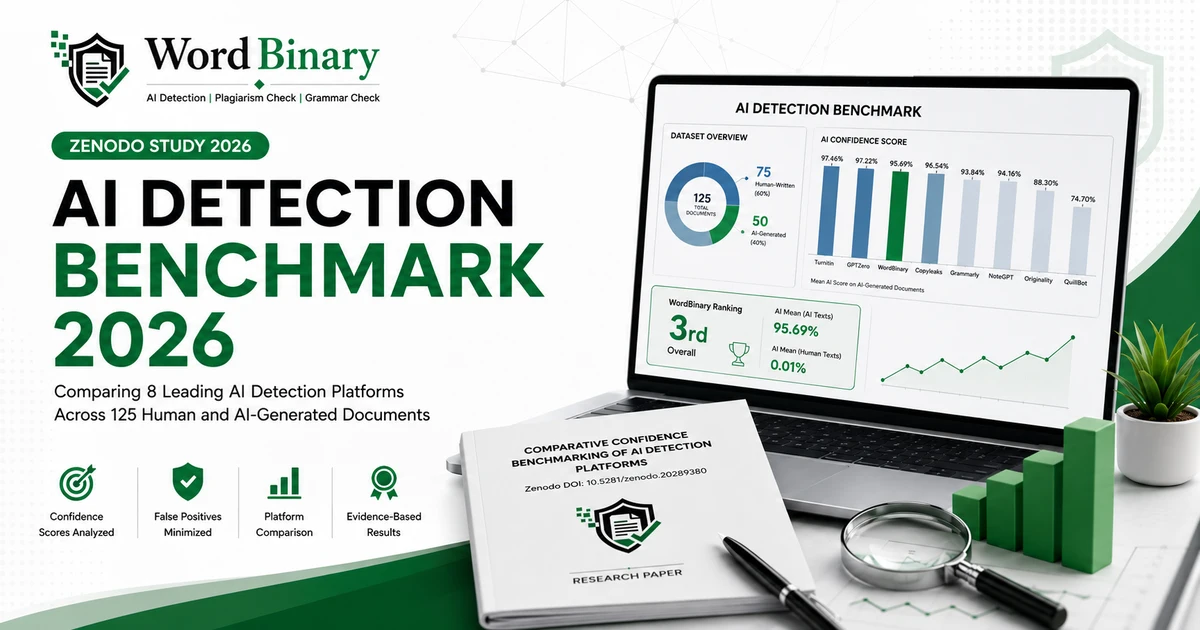
The AI Detection Confidence Benchmark 2026 is based on a Zenodo-published study that compared eight AI detection platforms across 125 human-written and AI-generated documents. The study found that accuracy alone is not enough to understand AI detector performance. Confidence scores, calibration, false-positive behaviour and score stability matter just as much.
Study discussed: Comparative Confidence Benchmarking of AI Detection Platforms Across Human and AI-Generated Multi-Domain Documents. The full paper can be retrieved from Zenodo here: https://zenodo.org/records/20289380
Quick Answer
A Zenodo-published benchmark study compared eight AI detection platforms across 125 documents, including 75 human-written documents and 50 AI-generated documents. The study evaluated WordBinary, Turnitin, GPTZero, Copyleaks, Originality, Grammarly, QuillBot and NoteGPT.
The headline finding was not simply that AI detectors can classify text as human or AI-generated. The more important finding was that different AI detectors may reach the same classification while assigning very different confidence scores.
In this benchmark, WordBinary ranked third in the study’s composite ranking. It recorded a 95.69% mean AI confidence score on AI-generated documents and a 0.01% mean AI score on human-written documents. That combination matters because a useful AI detector should not only identify generated text; it should also remain conservative when reviewing human writing.
This article explains what the benchmark tested, what the results mean, how WordBinary performed, and why institutions, students and academic integrity teams should think carefully before treating AI detector percentages as final proof.
Why This Benchmark Matters
AI detection has become one of the most debated areas in academic integrity. Universities, publishers, students, researchers and professional editors now face the same difficult question: when a document receives an AI score, how should that score be interpreted?
A simple answer would be convenient. A score above a chosen threshold means “AI”; a score below it means “human”. But real AI detection is not that simple.
Most AI detectors return percentages. Those percentages look precise, but they are not always directly interchangeable across platforms. A 95% AI score from one tool may not mean exactly the same thing as a 95% AI score from another. Each platform may use a different model, threshold, scoring scale, calibration method or reporting convention.
That is why this Zenodo benchmark is useful. It does not only ask whether AI detectors can separate human-written and AI-generated text. It asks a deeper question: how do different AI detectors behave when they score the same documents?
That distinction is important for anyone using an AI detector, especially in academic settings where a detection result may influence revision decisions, review workflows or misconduct discussions.
What the Zenodo Study Tested
The study, titled “Comparative Confidence Benchmarking of AI Detection Platforms Across Human and AI-Generated Multi-Domain Documents,” compared eight AI detection platforms using the same set of documents.
The dataset included:
| Benchmark Area | Details |
|---|---|
| Total documents | 125 |
| Human-written documents | 75 |
| AI-generated documents | 50 |
| Human share of dataset | 60% |
| AI-generated share of dataset | 40% |
| AI detectors tested | WordBinary, Turnitin, GPTZero, Copyleaks, Originality, Grammarly, QuillBot, NoteGPT |
| AI generators represented | ChatGPT, DeepSeek, Gemini, Perplexity |
| Main measurement | AI percentage scores treated as confidence values |
The design was useful because each platform reviewed the same document set. That allows a fairer comparison than testing one detector on one group of documents and another detector on a different group.
The study also used a confidence-based approach. Instead of treating every detector result as a simple pass-or-fail label, it analysed the AI percentage scores as continuous values. This made it possible to compare confidence intensity, calibration, agreement, separation between human and AI writing, and score stability.
That is the main reason this benchmark is worth discussing. It shifts the conversation away from a shallow question like “Which detector says AI?” and towards a more useful question: “How strongly, how consistently and how safely does each detector express confidence?”
Accuracy Alone Does Not Tell the Full Story
One of the most important findings from the study is that all eight platforms achieved perfect separation under several conventional threshold conditions. At thresholds such as 20%, 30%, 50% and 70%, all tools correctly classified the documents in this dataset.
At first, that sounds like the end of the story. If every tool classified correctly, why compare them further?
Because AI detector performance is not only about reaching the same label. It is also about the score behind that label.
For example, two platforms may both classify a document as AI-generated. One may assign a score of 75%. Another may assign 98%. Both results point in the same direction, but they communicate different levels of confidence.
That difference matters in real-world use. A student reviewing a draft, a researcher checking a manuscript, or an academic integrity officer reviewing a case may interpret 98% as stronger evidence than 75%. However, the benchmark suggests that such differences may sometimes reflect platform-specific scoring behaviour rather than a simple difference in truth.
This is why WordBinary’s own AI report review guide is an important supporting resource for users. AI detection results should be interpreted with context, not treated as automatic verdicts.
Key Findings from the Benchmark
The benchmark produced several important findings for anyone comparing AI detection tools.
| Finding | What It Means |
| All eight tools achieved AUC 1.00 | The human and AI documents were perfectly separable in this dataset |
| Human scores were near zero | All platforms were conservative on human-written documents |
| AI scores differed by platform | Tools agreed on classification but not always on confidence intensity |
| WordBinary ranked third overall | The composite ranking placed WordBinary behind Turnitin and GPTZero |
| WordBinary showed very low human scores | Its mean AI score on human-written documents was 0.01% |
| WordBinary showed high AI confidence | Its mean AI score on AI-generated documents was 95.69% |
| QuillBot scored AI texts lower | It classified correctly at normal thresholds but used a more conservative confidence scale |
| Calibration differed across tools | Some platforms’ confidence scores aligned more closely with ground truth than others |
The most practical lesson is simple: AI detector percentages should not be read as universal measurements. They are platform-specific confidence outputs.
How WordBinary Performed in the Study
WordBinary performed strongly in the benchmark, particularly on three areas that matter in academic and professional use: AI confidence, human-text conservatism and separation between human and AI writing.
The study reported the following WordBinary results:
| Metric | WordBinary Result |
| Mean AI score on human-written documents | 0.01% |
| Mean AI score on AI-generated documents | 95.69% |
| Mean separation between human and AI scores | 95.68 percentage points |
| AUC | 1.00 |
| Composite ranking | 3rd out of 8 |
The low human-written mean is especially important. False positives are one of the biggest concerns in AI detection. A false positive can create stress for students, confusion for instructors and risk for institutions. In this benchmark, WordBinary assigned near-zero AI scores to human-written documents.
The high AI-generated mean also matters. WordBinary assigned strong AI confidence scores to generated documents while maintaining a low mean score on human writing. That separation is one of the clearest signs of effective detector behaviour within this dataset.
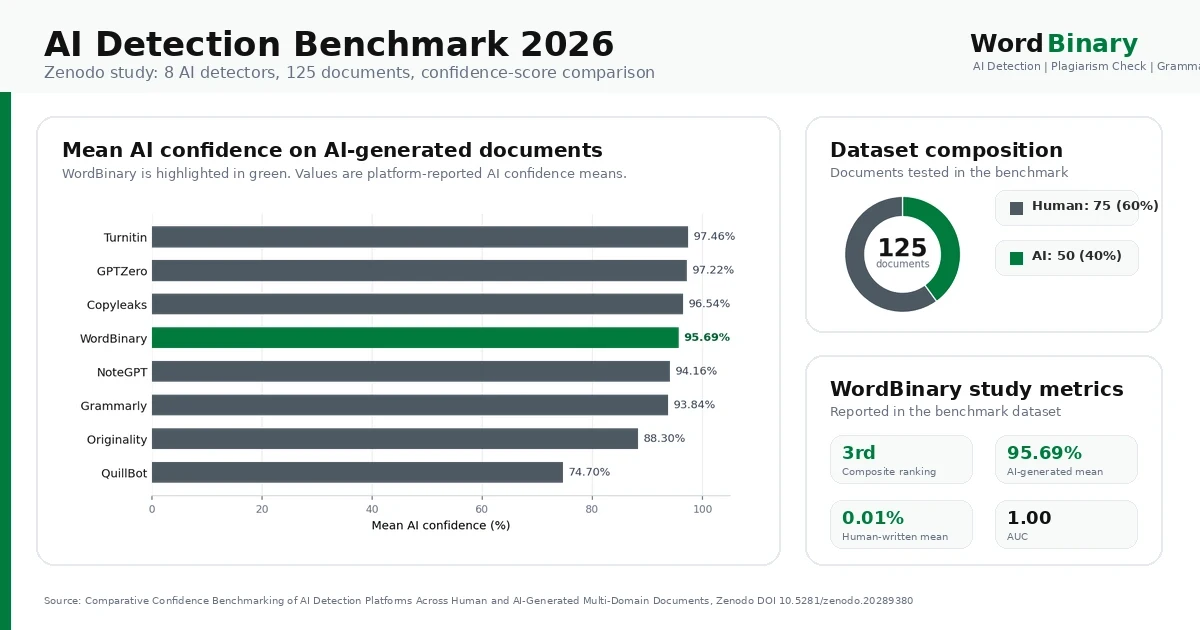
The study’s composite ranking placed WordBinary third, behind Turnitin and GPTZero, and ahead of Copyleaks, Grammarly, NoteGPT, Originality and QuillBot. However, the ranking should be interpreted carefully. It reflects the selected dataset, selected metrics and selected study design. It should not be exaggerated into a universal claim that any one detector is always better in every use case.
A careful interpretation is more credible: in this benchmark, WordBinary showed strong confidence-based performance and performed competitively among major AI detection platforms.
Users who want to understand how WordBinary’s detector is positioned can also read the Understanding WordBinary AI Detection guide.
AI Confidence Scores: The Real Difference Between Detectors
The benchmark’s most useful contribution is its focus on confidence scoring. In many AI detection discussions, people ask whether a tool is “accurate”. Accuracy is important, but it can hide meaningful differences. If every detector correctly labels a document as AI-generated, accuracy alone cannot explain which tool is more conservative, which tool is more confident, which tool is better calibrated, or which tool is more stable across different writing domains.
The study found that Turnitin, GPTZero, Copyleaks and WordBinary produced some of the strongest AI confidence scores on AI-generated documents. QuillBot, by contrast, produced much lower AI confidence scores while still correctly classifying AI-generated documents under common thresholds.
That is not necessarily a simple failure. It shows that QuillBot’s scoring scale behaved differently. The same broad classification can be paired with a lower confidence expression.
This matters because users often treat percentage scores emotionally. A 74% AI result may feel less serious than a 97% AI result. But the benchmark suggests that part of this difference may come from how each platform expresses confidence.
For universities and academic integrity teams, this is a major point. A detector score should be read as a signal that needs interpretation, not as a self-explaining judgement.
For students and researchers, the same principle applies. If your document receives an AI score, the next step should not be panic. The better step is to review the report, examine the highlighted sections, consider the writing style, check originality issues, and revise where needed.
Human-Written Text and the False Positive Problem
False positives are one of the most sensitive issues in AI detection. A false positive happens when human-written work is incorrectly flagged as AI-generated.
This concern is serious because academic writing often has features that can look machine-like. Formal structure, careful grammar, repeated terminology, predictable phrasing and technical language can all make human writing appear more regular than casual writing.
The benchmark found that human-written documents received consistently near-zero AI scores across all platforms. WordBinary and Turnitin recorded the lowest human mean values at approximately 0.01%.
For WordBinary, that is a valuable result because an AI detection tool should not only identify AI-generated text. It should also avoid over-accusing human writing. In academic contexts, conservatism on human-written documents is not a minor feature. It is central to fairness.
Anyone using AI detection in an academic setting should also read more about AI detection false positives. A responsible review process should consider the possibility of false positives, especially in high-stakes situations.
What the Study Found About AI-Generated Text
The platforms differed more clearly when evaluating AI-generated documents.
The reported mean AI scores for AI-generated texts were:
| Platform | Mean AI Confidence on AI-Generated Documents |
| Turnitin | 97.46% |
| GPTZero | 97.22% |
| Copyleaks | 96.54% |
| WordBinary | 95.69% |
| NoteGPT | 94.16% |
| Grammarly | 93.84% |
| Originality | 88.30% |
| QuillBot | 74.70% |
These results show that several platforms assigned high confidence to AI-generated texts. WordBinary was close to the leading group and produced a mean AI confidence score above 95%.
This is where the confidence-based approach becomes useful. If the study only reported that all tools classified correctly, readers would miss the difference between a detector that assigns a 75% mean AI score and one that assigns a 96% mean AI score.
For users comparing tools, this is exactly the kind of detail that matters. A detector is not just a label machine. It is a scoring system.
Calibration: Why a Percentage Score Needs Context
Calibration refers to how well a confidence score aligns with the actual ground truth. In simple terms, if a detector assigns high AI probability to AI-generated texts and very low probability to human texts, it is better calibrated than a detector whose percentages are less aligned with the labels.
The study used Brier scores to evaluate calibration. Lower Brier scores indicate better calibration. Turnitin, GPTZero, Copyleaks and WordBinary had some of the lowest Brier scores in the benchmark.
This is important because AI detector percentages are often interpreted like probabilities. But not every platform’s percentage scale behaves the same way. A score of 90% from one tool may not be calibrated in the same way as a score of 90% from another.
For practical use, this means users should avoid over-reading the exact number. The better approach is to combine:
- the AI percentage score,
- highlighted text or sentence-level indicators,
- the writing context,
- originality or similarity findings,
- the document’s revision history,
- and human review.
This is why combining AI detection with originality review can be helpful. A user may want to run an AI check through the WordBinary AI Detector and also review overlap through the WordBinary Plagiarism Checker, especially before submitting academic work.
Domain and Generator Stability
The study also looked at whether AI detection confidence changed significantly across subject domains or AI generator sources.
The AI-generated documents came from multiple generators, including ChatGPT, DeepSeek, Gemini and Perplexity. The benchmark did not find statistically significant differences by generator source. This suggests that, within this dataset, the evaluated detectors were broadly stable across the AI sources represented.
The study also examined domain-level variation. Again, no statistically significant domain-level instability was found in the dataset.
This is useful, but it should be interpreted carefully. A dataset of 125 documents can provide meaningful benchmark insights, but it cannot represent every subject, writing style, language background, prompt type or editing pattern. AI detection performance may differ when texts are paraphrased, heavily edited, translated, written by multilingual authors, or produced through hybrid human-AI workflows.
That is why benchmark studies should continue expanding. The strongest future evaluations should include more ambiguous documents, edited AI text, human-AI mixed writing, paraphrased outputs and multilingual samples.
What This Means for Universities
For universities, the benchmark supports a balanced approach to AI detection.
The most important lesson is that AI detector results should be treated as indicators, not final proof. A detection score can help start a review, but it should not replace academic judgement, policy interpretation or student communication.
Universities should avoid relying only on binary labels. A label such as “AI-generated” may hide important details about confidence intensity, calibration and uncertainty. Instead, institutions should ask:
- How high was the score?
- Which sections were flagged?
- Does the writing style match the student’s known work?
- Is there any draft history?
- Does the result agree with other evidence?
- Could the writing style produce a false positive?
- Was the detector used within the institution’s stated policy?
These questions are especially important because AI detection results can affect students’ academic records, appeals and trust in the institution.
For institutions looking for a practical review workflow, WordBinary can support pre-submission checks, document review and AI report interpretation. However, the result should always be used responsibly and in context. The Turnitin vs WordBinary guide and Turnitin Alternative Guide may be useful for readers comparing direct-access academic review tools.
What This Means for Students and Researchers
For students and researchers, the study offers a different lesson: do not treat AI detection as a mystery box.
If a document receives a high AI score, the right response is not simply to rewrite everything blindly. The better response is to review the report carefully. Look for sections where the writing may be unusually generic, overly uniform, repetitive or structurally predictable.
A good review process may include:
- checking the AI score,
- reviewing highlighted passages,
- improving personal voice and specificity,
- checking citations and source use,
- reviewing similarity scores,
- correcting grammar and clarity issues,
- and keeping drafts or notes where appropriate.
WordBinary is useful in this context because it brings AI detection, plagiarism checking and writing review into a more accessible workflow. Students who are preparing essays, reports, dissertations or research drafts can use the platform before submission to understand possible issues early.
For broader writing quality, users can also review the Grammar Check Tool Guide and the Plagiarism Report Review Guide.
Why AI Detector Comparison Needs Better Metrics
Many AI detector comparisons focus on one question: which tool is most accurate?
That question is understandable, but incomplete.
A better comparison should include at least six dimensions:
| Evaluation Area | Why It Matters |
| Human-text conservatism | Reduces the risk of false positives |
| AI-text confidence | Shows how strongly generated content is detected |
| Separation | Measures the distance between human and AI scores |
| Calibration | Tests whether percentages align with ground truth |
| Stability | Shows whether scores are consistent across documents |
| Agreement | Compares whether tools behave similarly or merely classify similarly |
The Zenodo study is valuable because it looks beyond simple accuracy and examines confidence behaviour. This kind of analysis is more useful for real users because AI detector percentages are not just technical outputs. They shape decisions.
A university may use them to support a review. A student may use them to revise an essay. A publisher may use them to screen submissions. A researcher may use them to understand the originality and authorship profile of a draft.
In all of those cases, confidence behaviour matters.
What the Benchmark Does Not Prove
A strong article about research should also explain limitations. This is important for trust.
The benchmark does not prove that any AI detector will perform perfectly in every future case. It does not prove that WordBinary, Turnitin, GPTZero or any other detector is universally accurate across all possible writing styles.
The study had several limitations:
- The dataset contained 125 documents, which is useful but still limited.
- The human and AI samples appeared clearly separable.
- The study did not focus on adversarially paraphrased AI text.
- It did not fully test heavily human-edited AI writing.
- It did not cover every language, discipline, prompt style or AI generator.
- Platform percentages may not be calibrated identically.
- Some domain and generator subgroups were relatively small.
These limitations do not weaken the value of the study. They make the interpretation more precise. The study is best understood as a confidence-based benchmark of eight AI detection platforms under a defined dataset and methodology.
That careful framing is important. AI detection is an evolving field, and responsible tools should be evaluated through repeated, transparent and methodologically diverse studies.
Why WordBinary’s Result Is Significant
WordBinary’s result is significant because it performed competitively in a benchmark that included established AI detection names such as Turnitin, GPTZero, Copyleaks and Originality.
The most important WordBinary findings were:
- third place in the study’s composite ranking,
- 95.69% mean AI confidence on AI-generated documents,
- 0.01% mean AI score on human-written documents,
- 1.00 AUC within the evaluated dataset,
- strong separation between human and AI writing,
- and low calibration error compared with most tools in the benchmark.
For a platform built around academic document review, those findings are meaningful. They support WordBinary’s position as a serious AI detection and academic review tool, especially for users who want accessible AI checking, similarity review and downloadable reports.
At the same time, the result should be described responsibly. The correct conclusion is not “WordBinary is always better than every other detector.” The correct conclusion is stronger and more credible:
In this Zenodo benchmark, WordBinary showed high AI-confidence performance, very low human-text scores and strong overall ranking among the eight evaluated AI detection platforms.
That is the kind of claim that can be supported, cited and trusted.
Practical Takeaways
The benchmark gives readers several practical lessons.
First, AI detector percentages are not universal. A score from one platform should not automatically be treated as equivalent to the same score from another platform.
Second, accuracy alone is not enough. When multiple tools classify correctly, the meaningful differences appear in confidence, calibration and stability.
Third, false positives matter. A useful detector should be careful with human writing, especially in academic settings.
Fourth, AI detection should not be used in isolation. The best review process combines detection scores with writing context, similarity analysis, document history and human judgement.
Fifth, WordBinary’s performance in the study was strong. It ranked third in the composite ranking and showed a combination of high AI confidence and near-zero human scores.
For users who want to test documents directly, the WordBinary AI Detector is the most relevant starting point. Users who also want to check originality can use the Plagiarism Checker, while institutions or teams can review available plans on the Pricing page or contact WordBinary through Contact Support.
Conclusion
The Zenodo benchmark shows why AI detection should be evaluated with more care than a simple accuracy score can provide.
In the study, all eight AI detection platforms separated human-written and AI-generated documents under conventional thresholds. But the deeper finding was that platforms differed in how they expressed confidence. Some tools assigned much higher AI confidence scores than others, even when they reached the same classification outcome.
WordBinary performed strongly in this confidence-based comparison. It recorded high AI confidence on generated documents, near-zero scores on human-written documents and a third-place composite ranking among the eight evaluated platforms.
For students, researchers, universities and academic integrity teams, the lesson is clear: AI detection scores should be read as evidence signals, not automatic verdicts. The best use of AI detection is careful, contextual and supported by human review.
This is where confidence-based benchmarking becomes valuable. It helps users move beyond the question “Did the tool say AI?” and towards the more useful question: “How reliable, calibrated, conservative and interpretable is the score?”
That is the future of responsible AI detection.